

Roof leak repair in Winter Park, FL is mostly detective work. The stain on your ceiling marks where water found a way down, not where it got in, and under live oaks and near-daily summer thunderstorms there are a dozen suspects. A patch over the wrong spot just moves the drip.
We answer the phone 24/7 and send a licensed roofer who traces the leak from the attic and the roof surface, explains what failed, and gives you a written price before work starts. If water is coming through right now, start with emergency roof repair and tarping, and read what to do when your roof is leaking during a storm while you wait. Don't climb onto a wet roof yourself.
Where Winter Park roofs leak first: valleys, pipe boots, wall and chimney flashing, skylights
Leaks almost always start where the roof is interrupted: a pipe, a valley, a wall, a chimney or a skylight. The roofer checks these spots first.
Pipe boots
Plumbing vents pass through the roof inside a flashing boot with a rubber collar. Florida sun cracks that collar, often years before the shingles wear out, and water runs down the pipe into the ceiling below. Pipe boot replacement is one of the most common leak fixes on the 1950s to 1970s homes that make up most of Winter Park.
Valleys
A valley carries the water from two roof planes, so it handles more flow than any other part of the roof. A valley leak usually comes from worn or cut shingles in a closed valley, rusted or short valley metal, or debris that dams water and pushes it sideways under the covering.
Wall flashing: step flashing and kick-out flashing
Where a roof meets a second-story wall or dormer, each shingle course needs its own step flashing tucked behind the siding or stucco, and a kick-out flashing at the bottom turns water into the gutter. Without the kick-out, water runs behind the stucco and stains an interior wall, which homeowners often blame on the windows.
Chimney flashing
Chimneys need base flashing on the roof and counterflashing set into the masonry above it. On many older Winter Park homes the counterflashing was simply caulked to the brick face, and once that caulk dries out, water slips behind it. Proper chimney flashing repair cuts the counterflashing into a mortar joint instead of relying on sealant.
Skylight leaks
A skylight leak usually comes from the curb flashing, not the glass. Sealant and flashing loosen with heat cycles, and debris piles against the uphill side of the curb. Sometimes the fix is new flashing; on an older unit, replacing the skylight can make more sense.

What a roof leak repair visit includes
A leak visit should leave you knowing exactly where the water got in and what it takes to stop it. These are the pieces you should expect, whether the roof is shingle, tile or a low-slope section.
- An attic check of the deck boards, rafters and insulation above and uphill of the stain, wherever it can be reached safely.
- Moisture meter readings on the ceiling and deck, so an active leak is told apart from an old, dried stain.
- A close look at every pipe boot, vent, valley, wall flashing, chimney and skylight curb upslope of the wet area.
- A controlled hose test, one small zone at a time, when the entry point still isn't visible.
- Labeled photos of the failed part, the water trail it left and the condition of the roof around it.
- A written scope and price naming the fix, plus anything that wasn't opened or tested.
- Temporary protection if water is coming in now, priced on its own line, separate from the permanent repair.
Our roof leak repair process, step by step
The tracing methods get their own section below. This is the whole job around them, from your first call to the first heavy rain after the fix.
- Tell us what the stain doesWhen you call, we ask where the water shows up, whether it appears only in storms or on sunny days too, which way the wind was blowing and roughly how old the roof is. Those answers tell the roofer where to start.
- Trace it from the attic to the roofThe roofer works from the attic above the stain up to the flashings and penetrations on the roof itself. If nothing gives the source away, a zone-by-zone water test narrows it down on a dry day.
- See the cause before you approve anythingYou get photos of the cracked boot, loose flashing or worn valley, and of the trail the water followed. The written price names the repair and anything that could change once the covering is lifted.
- Fix the source and check its neighborsThe roofer replaces the failed part instead of coating over it, matches shingle or tile as closely as available stock allows, and checks the other boots and flashings, since one sun-cracked collar is rarely the only one.
- Watch the next hard rainPencil a line around the edge of the old stain. If it stays dry through the next few afternoon storms, the leak is stopped. If it spreads past the line, call back so the same area gets rechecked.
Finding the source: attic check, moisture readings and a controlled water test
Water hits the underside of the roof deck, runs along it or down a rafter, and drops wherever gravity wins. That can be several feet downslope, or even sideways, from the real opening. Roof leak detection follows that trail backward.
- Attic check. With a flashlight, the roofer looks for dark stains on the deck boards, wet or matted insulation, rusty nail tips and water trails on rafters, then follows the trail uphill to its highest point.
- Moisture readings. A moisture meter on the ceiling drywall and the deck tells an active leak from an old, dried stain, and shows how far the wet area spreads.
- Roof surface inspection. The roofer checks every penetration and flashing directly above and upslope of the wet area: boots, vents, valley metal, wall and chimney flashing, skylight curbs.
- Controlled water test. If the source still isn't obvious, a garden hose runs on one small zone at a time, starting low and working uphill, while someone watches inside. When the drip starts, the zone is found.
Why the patch-and-pray approach fails
Smearing roof cement over every seam near the stain hides the real entry point and can trap water in the deck. A traced leak gets one targeted repair instead.
Shingle roof leak repairs: lifted tabs, nail pops and failed sealant
On asphalt roofs the usual culprits are tabs that lifted in a gust and never resealed, nails that backed out and push up through the shingle above, and cracked sealant at flashings. Each opens a path that wind-driven rain finds.
Shingle repair means replacing the damaged shingles, re-nailing in the right place, resealing tabs and renewing the flashing detail that failed. Older roofs need care because brittle shingles crack when lifted. That is everyday work on second- and third-generation shingle roofs in Goldenrod and on the low-pitch ranch homes of Casselberry, and across the rest of our service areas around Winter Park.
Tile roof leaks: when the underlayment is the real problem
On a clay or concrete tile roof the tile sheds most of the water, but the underlayment beneath it is the true waterproof layer. After 20 years or more in Central Florida heat, that underlayment dries out and tears, and the roof starts leaking even though the tiles look fine from the street.
Cracked tiles from foot traffic or a falling limb, loose ridge mortar and clogged valley metal also let water in. Small leaks can be fixed by lifting tiles, repairing the underlayment and flashing, and resetting them. When the underlayment is worn across a whole section, the honest answer is a lift and relay. Our tile roof repair page covers that process for the Mediterranean-style and lakefront homes where tile is common.
Leaks under the oak canopy: leaf-dammed valleys, limb scuffs and overflowing gutters
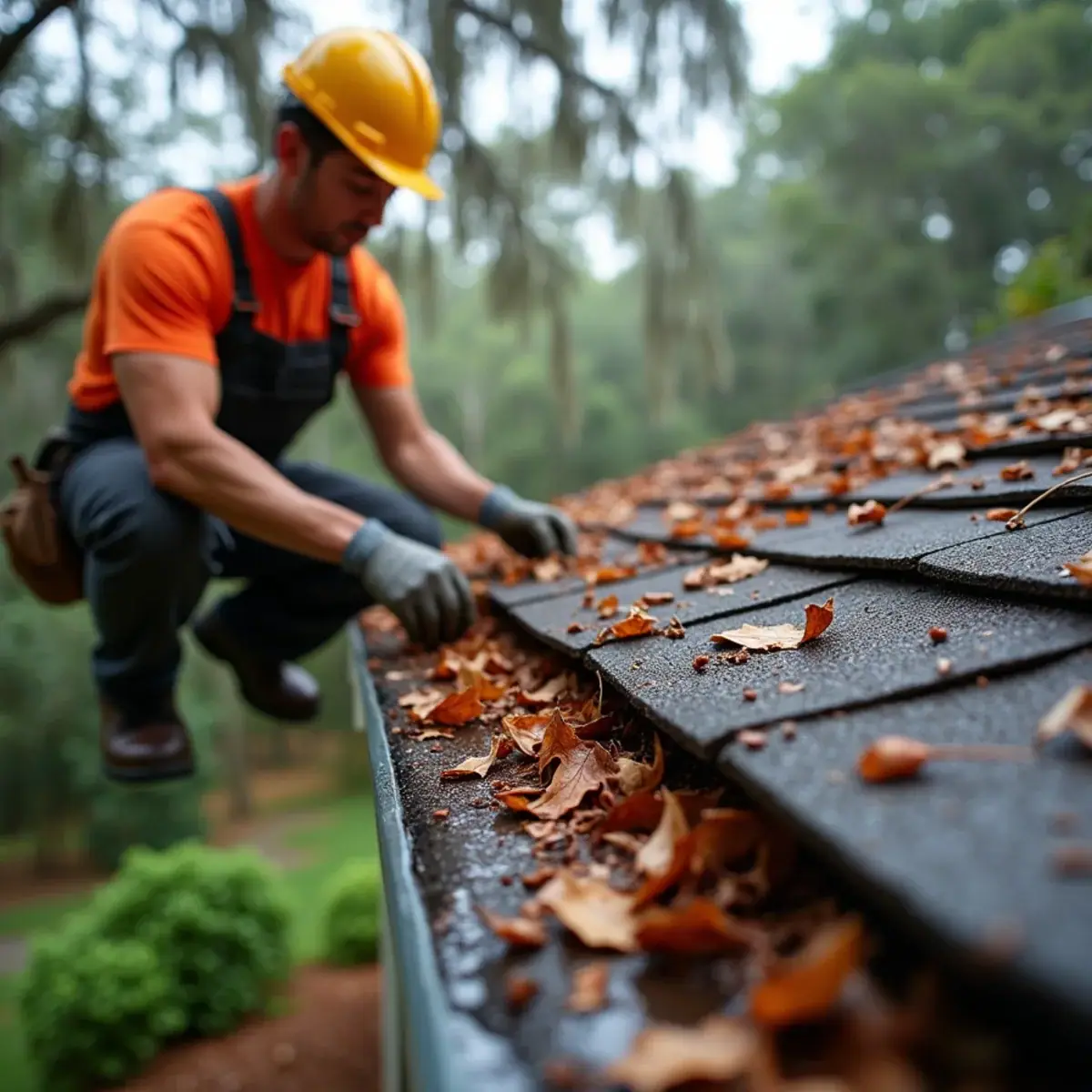
Winter Park's live oaks drop leaves through spring, and their branches rub roofs whenever the wind picks up. Leaves hold water against the roof and push it under the covering during a downpour.
- Leaf dams in valleys and at the uphill side of chimneys and skylights.
- Limb scuffs that grind granules off shingles or crack tiles where branches touch the roof.
- Small punctures from falling deadwood that look like nothing from the ground.
- Overflowing gutters that send water behind the fascia and into the soffit.
The same pattern shows up on the oak-shaded lakefront streets of Maitland. If a limb actually came down on the roof, the work moves into storm damage roof repair, with photos of the damage for your records.
A ceiling stain with no storm: slow leaks, attic condensation and AC drain lines that mimic a roof leak
Not every ceiling water stain is the roof's fault. In Central Florida the air handler often sits in the attic, and it produces a steady stream of condensate. A clogged drain line or an overflowing secondary pan drips onto the ceiling on dry, sunny days. Uninsulated or leaky ductwork sweats in humid summer air and leaves rings that look exactly like a roof leak.
Bath fans vented into the attic cause the same confusion. A roofer who checks the attic first will tell you when the stain points to the HVAC or plumbing instead of the roof, so you don't pay for a roof repair that doesn't stop the drip. A stain that only appears after rain, and grows after heavy rain, is almost always the roof.
Repair or replace: what roof age and Florida's 25% rule mean for a leak
One failed boot or flashing on a roof with good years left is a repair. Several leaks in different places, brittle shingles or soft decking across a slope point toward replacement. Age matters too: Florida insurers look hard at roofs past 15 years, and a repair does not reset the roof's age.
Florida Building Code also limits how much can be patched. If more than 25% of a roof section is repaired, replaced or recovered within 12 months, that section generally has to be brought up to current code. Since 2022, if your existing roof was installed under the 2007 Florida Building Code or a later edition, only the repaired portion must meet current code. The roofer will tell you which applies to your home. If the numbers point to a new roof, see roof replacement in Winter Park.
What affects the cost of a roof leak repair
Every leak is priced on what the roofer finds, and you get a written price before work starts. The main drivers are:
- Roof material: tile takes more labor to lift and reset than shingle, and matching older tile or discontinued shingles takes time.
- Pitch and access: steep slopes, two-story eaves, oak limbs and tight lots need more safety setup.
- What failed: a pipe boot is a small job; rebuilding chimney counterflashing or a valley is a bigger one.
- Hidden damage: rotted decking or fascia found once the covering is opened.
- Permits where the repair requires one, and after-hours calls during a storm.
For more on each factor, read what drives roof repair cost in Winter Park. Every roofer we send is licensed and insured in Florida.
Why Winter Park homeowners call Zana Roofers for roof leak repair
- A drip at 9 p.m. still gets an answerLeaks show up during evening thunderstorms, not office hours. Our phone is answered 24/7, so you can describe the stain while it is still wet and the roofer arrives knowing where to look first.
- The entry point, shown in photosInstead of being told the roof "needs work", you see the exact boot, flashing or valley that failed, and the written price is in your hands before anyone starts the repair.
- One leak doesn't sell a new roofWhen a single failed part caused the stain and the rest of the roof is sound, the roofer recommends the repair. If several leaks point toward replacement, you get the evidence behind that call too.
- Roofers who know where local roofs leakLeaf-dammed valleys under the oak canopy, dried-out underlayment beneath intact tile and the tie-in where a flat Florida room meets the main roof are the leaks the roofers we send trace most often.
Roof Leak Repair questions from Winter Park homeowners
How fast can a roofer get to a leaking roof in Winter Park?
We answer the phone 24 hours a day and send a licensed roofer as soon as it is safe. Timing depends on the weather and call volume after a storm, so we don't promise a set arrival time. Nobody works on a roof during lightning or high wind; the roofer comes once the storm passes.
Can you find a roof leak when it is not raining?
Yes, in most cases. Water stains on the roof deck, wet insulation and moisture meter readings show where water has been traveling, and the roofer follows that trail to the flashing or penetration above it. When the source still isn't clear, a controlled water test with a hose, run one small zone at a time, recreates the leak on a dry day.
Will a repair on an older roof satisfy my insurance company?
Not always. A repair stops the leak, but insurers judge the whole roof by age and condition. Under Florida law, an insurer can't refuse to write or renew a policy solely because a roof is under 15 years old, and for older roofs it must accept an inspection showing at least five years of remaining useful life. Insurers can still apply other underwriting rules, so confirm with your agent.
Do I need a permit for a roof repair in Winter Park?
Often, yes. Inside city limits, the City of Winter Park Building and Permitting Services issues roofing permits, and many repairs as well as all reroofs need one. Homes in unincorporated Orange or Seminole County go through the county building office. The licensed roofer pulls the permit and schedules any inspection, so you don't have to file anything yourself.
Is a brown ceiling stain always a roof leak?
No. In Central Florida, a clogged AC condensate line, an overflowing drain pan in the attic, sweating ductwork or a bath fan venting into the attic can all leave stains that look like a roof leak. If the stain appears on dry days or near the air handler, the cause is likely inside the attic. The roofer checks the attic first and tells you which it is.
How long does a roof leak repair take?
Most single-point repairs, such as a pipe boot, a few shingles or a run of step flashing, take a few hours once the roofer is on site. Tile leaks take longer because the tile has to be lifted, the underlayment fixed and the tile reset. A rebuilt valley, new chimney counterflashing or rotted decking can stretch to a full day or more, and a permit or hard-to-match material adds waiting time.
Can a roof leak be fixed from inside the attic?
No, not permanently. Water gets in through the roof covering or a flashing, so the lasting fix has to be made on the roof surface. From the attic, a roofer can trace the water trail, take moisture readings and sometimes slow an active drip while lightning keeps everyone off the roof. Sealant smeared on the underside of the deck traps water in the wood and hides the real entry point.
Page reviewed by Zana Roofers.